Livy in Latin — Read & Translate Ab urbe condita
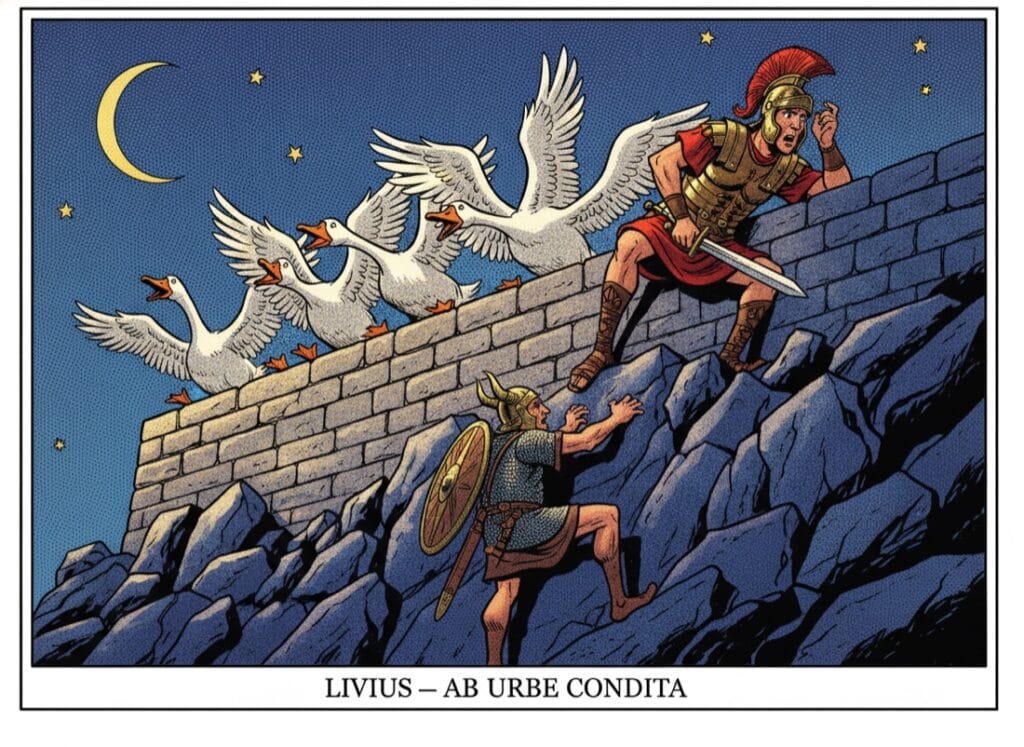
Livy (Titus Livius, 59 BC–AD 17) is the great storyteller of Roman history — his work Ab urbe condita once ran to 142 books and begins at the founding of the city. In class you meet him above all in Book 1 (Romulus, Numa, the rape of the Sabine women) and Book 5 (the Gauls, the Capitoline geese, Vae victis). The appeal: vivid, concrete narrative. The hurdle: Livy’s long, artfully built periods. That is exactly where our idea comes in: read the same author in stages — from a gently simplified version matched to your level up to the verbatim original. This page belongs to our Learn Latin section and leads straight into our in-app reader.
Important: this is not a grab-bag of level sentences — you practise those in the Sentence Quiz. In the reader you get the real Livy as a connected narrative, on the historical material. Because context carries understanding — fragments never become reading.
- Who Livy was — and why Ab urbe condita is a classic school author
- The famous cry Vae victis! in the original, with our own translation
- How the app grades Livy from simplified to the original
- The typical Livy pitfalls — long periods, the historical present, oratio obliqua
- Common student mistakes and how to avoid them
Who was Livy?
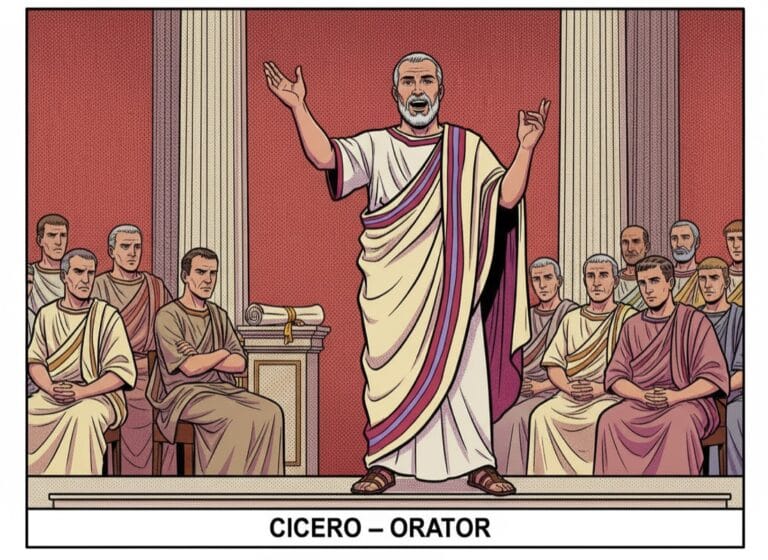
Titus Livius (59 BC–AD 17) spent some forty years writing his monumental history Ab urbe condita (“From the Founding of the City”), which told the whole of Roman history from Aeneas down to his own day. Of the original 142 books, 35 survive. For the classroom, Livy is the great narrator: dramatic, vivid and moral — famous for his “milky richness” (lactea ubertas), the broad, flowing period style on which translation must prove itself.
The cry Vae victis! — in the original
In Book 5 Livy tells how the Gauls capture Rome and demand gold as ransom. When the Romans protest at the false weights, the Gallic chieftain Brennus throws his sword too onto the scale and sneers:
Vae victis!
Livy, Ab urbe condita 5,48
Our translation: “Woe to the conquered!” Two words that hold the whole harshness of the logic of power — a proverb to this day. From the same fifth book comes the episode of the Capitoline geese (5,47), whose cackling saves the Roman citadel from the Gauls creeping up by night.
You can check the Latin wording against free editions: The Latin Library, the original text at Wikisource, and the overview at Wikipedia.
In stages to the original — how the app grades the text
Reading research names a hard threshold: only when you know about 95% of the words in a paragraph do you read fluently. Jump straight from the textbook into Livy’s periods and those 95% are almost always missing. So we read the same Livy material in stages: first a simplified narrative matched to your level, then steadily harder — up to the unchanged original. The cognitive load is shared, and forms and vocabulary are recycled again and again in real sentence context.
In our in-app reader Livy is built as a ladder of real episodes — from an easy start to the original:
| Stage | Episode in the app | Focus |
|---|---|---|
| stage L12 | Ab urbe condita I · Numa Pompilius | A narrative start |
| stage L15 | Ab urbe condita I · Romulus and Remus | Rome’s founding legend |
| stage L18 | Ab urbe condita III–V · Camillus | The Republic, larger periods |
| stage L27 · original | Ab urbe condita V · The geese / Vae victis | Livy’s unchanged text |
From the entry to the original — the two ends of the ladder
Here is what the path looks like. On the left the narrative entry from “Romulus and Remus (stage L15)”; on the right the unchanged original from “The geese / Vae victis (stage L27)”:
Entry · stage L15
“Vastae tum in his locis solitudines erant. Faustulo fuisse nomen ferunt.”
At that time there were vast wildernesses in these places. They say his name was Faustulus.
Original · stage L27 (Livy, AUC V)
“Anseres non fefellere, quibus sacris Iunonis in summa inopia cibi tamen abstinebatur.”
The geese, by contrast, did not fail to notice — the birds sacred to Juno, from which, despite the greatest shortage of food, the Romans nevertheless kept away.
Real Livy both times — only the difficulty grows: the short narrative sentence against Livy’s interlocking period with archaic fefellere (= fefellerunt), an embedded relative clause and the impersonal abstinebatur. Find the frame first — subject and main verb — then hang the subordinate clauses on it.
Key idea: the hardest text does not make you better — the one you understand at 95% does, and then one step higher. That is how you reach the original safely.
Learn Latin now. Our learning app:

The Livy pitfalls — and how to crack them
Livy narrates grippingly, but in long, rich periods. Three features cost students the most marks in exams. One example each:
1. The long period
Livy’s sentences are often long, full of participles, ablatives absolute and subordinate clauses — it is easy to lose the subject and main verb. Do not read word for word; find the frame first: where is the finite main verb, where is its subject? Only then hang on the subordinate clauses and participles. See the ablative absolute.
2. The historical present
In the middle of a past narrative Livy suddenly switches to the present to make a scene vivid: mittit, iubet, oppugnat. This historical present is smoothed into the past tense in translation — “he sent, ordered, attacked.” Do not change tense mid-report in English.
3. Oratio obliqua
Livy reports the speeches of generals and senators almost always in indirect speech — a huge structure of accusative-and-infinitive (in main clauses) and subjunctive (in subordinate clauses), often over many lines. Carry the governing “he said that …” in your mind until the speech ends. More at oratio obliqua.
| Pitfall | Signal | Most common mistake |
|---|---|---|
| Long period | many participles/clauses, late main verb | word for word instead of frame first |
| Historical present | present in the middle of a past report | present carried over into English |
| Oratio obliqua | long ACI + subjunctive after a verb of saying | “that” thread lost, subjunctive as “would” |
Frequently asked — Livy
Is Livy hard to translate?
Livy narrates vividly, but in long periods. The main difficulties are the sentence structure with many participles, the historical present and oratio obliqua. Find the sentence frame first, read in stages, and you will manage well.
From what level can I read Livy?
Simplified versions of the founding legends (Romulus, Numa) can be read from the third year. The unchanged original of Ab urbe condita is typical upper-school and exam level.
What does Vae victis mean?
Vae victis means ‘Woe to the conquered!’. The Gallic chieftain Brennus says it in Livy (Ab urbe condita 5,48) as he throws his sword too onto the scale with the ransom. It is a proverb to this day.
What does Ab urbe condita mean?
Ab urbe condita means ‘From the Founding of the City’ and is the title of Livy’s history. It told Roman history from the beginnings in an original 142 books, of which 35 survive.
Learn Latin now. Our learning app: