
What is the story?
A continuous narrative across all four years that ties a large part of the practice sentences together. Instead of loose filler sentences, you follow a story with recurring characters — grammar and storytelling in the same sentence. The core theme: “Skill beats strength — and status.” The clever Germanic outsider solves with his wits what the great and the mighty can’t manage with muscle and birthright. Warm-hearted, tongue-in-cheek, set in late-republican Rome — with a dash of Asterix.
The characters
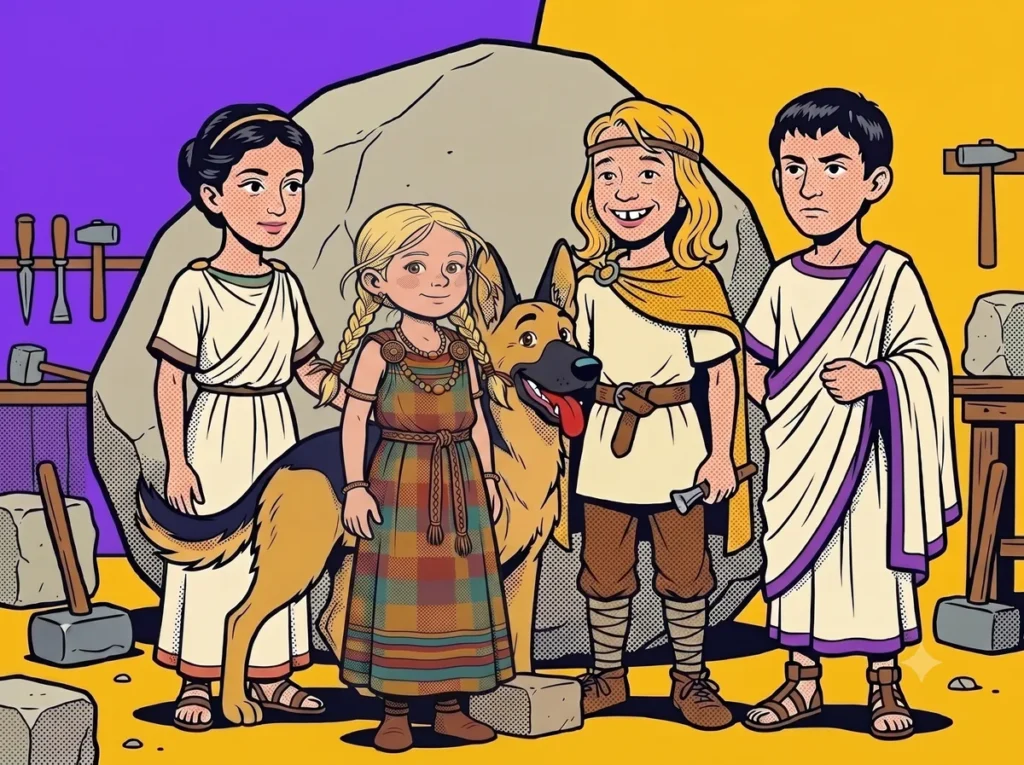
- Ariovistus — the main character. Son of a Germanic stonemason, small and slight but clever; a stranger in Rome and the glue that holds the friends together.
- Lupus — Ari’s dog. The bridge across every class barrier: everyone loves him, right across society — and often he’s the key to the solution.
- Wotan — Ari’s father, a Germanic stonemason (lapicida). He works for the powerful men of Rome — valued for his skill, rejected for his standing.
- Hilda — Ari’s brave sister.
- Iulia — Caesar’s daughter, clever and cunning. Between her and Ari there’s a tender, forbidden affection.
- Marcus — Cato’s son, strong and proud, Ari’s best friend: they tease and rib each other, but they stick together.
- Titus — son of a grain merchant and Ari’s first Roman friend.
- Caesar & Cato — the two stern fathers who reject the lower-class boy — but adore his dog.
- Antonius — a young, charming nobleman; hungry for life, chronically in debt, a lovable rogue.
The story — Year 1
“Ariovistus comes to Rome” — the backstory. Ari arrives with Lupus to join his father Wotan and finds his feet in a strange city: the house, the quarry out in the country, the school where the citizen’s son Titus is the first to hold out his hand. He visits the stern Cato, who thaws of all things over the dog, meets slaves with compassion, and weathers a storm in which Lupus is lost and found again. In the end Wotan’s stonework is honoured — the man behind it stays in the shadows. Everyday life, first friendships, finding your place.
The story — Year 2
The adventures of the three friends. Ari sneaks off in secret to Iulia, outwits a market strongman, saves the reckless Marcus from the scaffolding with a block and tackle — again and again cunning beats brute force. He tells of his own flight from Germania with his sister Hilda, across the Alps all the way to Rome. Bigger intrigues come into play: a stolen diadem, a theft Ari is wrongly suspected of — and friends who stand by one another despite exclusion. Courage shows itself quietly (virtus), friendship carries across the class divide. Bittersweet, comic, human.
The story — Years 3 and 4
The friends grow older and the stakes grow higher: childhood adventures give way to the entanglements of the adult world. With the fourth season, Ari’s story moves towards its finale — between family happiness and political intrigue, between betrayal and treachery, and an alliance that will change Rome forever.
Narrative and reading — the same world, twice over
The story meets you in two places: as practice sentences in the trainers — the same sentence can come back in the forms trainer, the sentence quiz and Sensus (marked with 🧠) — and as a connected reading text that you read sentence by sentence. As you go, Lapicida shows you the matching vocabulary and the matching grammar for the text. So you don’t collect isolated forms, you read a story whose words and constructions you’re learning right now.
Why a narrative? The science behind it
- The frame. Recurring characters and a through-line connect grammar and meaning. Recognition anchors more deeply than a constant stream of new filler.
- Less mental load. A familiar context and familiar characters ease the working memory, rather than overloading it with a mass of new individual parts (Cognitive Load Theory, Sweller 1988) — leaving capacity for the actual understanding.
- Identification. Someone rooting for Ari reads differently from someone translating an arbitrary example sentence. Involvement keeps you alert and makes knowledge stick better.
Common questions
Do I have to read the story in order to practise?
No. You can use each module on its own. But many practice sentences belong to the continuous story — and through the reading text you can follow the story as a whole, if you like.
Is it all historically accurate?
The world is genuine late-republican Rome with genuine material culture — but deliberately dated loosely and told with a wink. It’s about understanding and the joy of the language, not the exact year.
Try it now
The first chapters are included in the free area — no account, no credit card. Start for free →
← Back to overview · on to the Reading or to the Curriculum