Virgil: The Aeneid — Learn It from Adapted Text to the Original
For most learners, Virgil’s Aeneid is the first real piece of Latin poetry they ever read — Rome’s national epic. The reason for the awe is well known: between textbook sentences and Virgil’s hexameter lies the notorious „reading shock“. Our idea tackles exactly that: read the same text in stages — from an adapted version matched to your year of study up to the verbatim original. This page belongs to our Learn Latin section and leads straight into the in-app reader.
Important: this is not a pile of level-matched sentences — you drill those in the Satzquiz. Here you read the real Virgil as a connected text, following the saga of Aeneas. Context carries comprehension; fragments never become reading.
- What the Aeneid is — and why Virgil is the classic school poet
- The famous opening line „Arma virumque cano“ in the original, with our own translation
- How the app grades the same Aeneid text from adapted to the original
- The four hurdles in Virgil — hexameter, hyperbaton, poetic forms, participles
- Common student mistakes and how to avoid them
What is Virgil’s Aeneid?
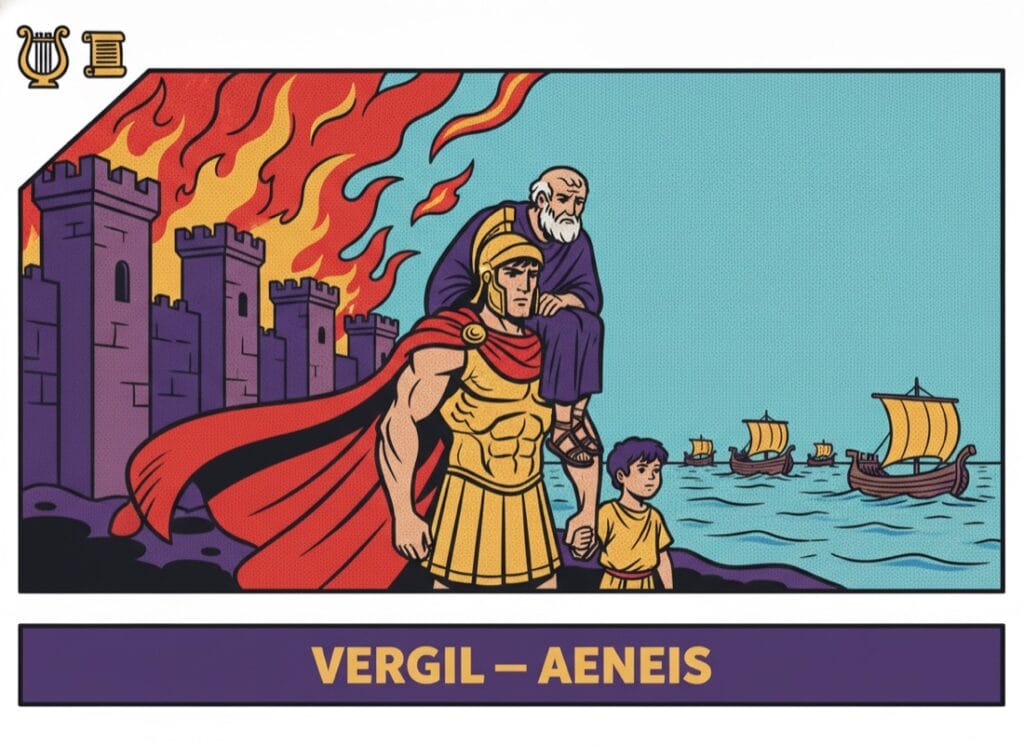
The Aeneid is Virgil’s twelve-book epic about the Trojan Aeneas, who flees the fall of Troy across the sea to Italy and becomes the ancestor of Rome (written c. 29–19 BC). It is Rome’s national epic of the Augustan age and a model of pietas — and, at the same time, political poetry. Anyone learning to read and translate the Aeneid usually starts with the proem and Book One.
„Arma virumque cano“ — the opening line of the Aeneid in the original
Few Latin lines are quoted as often as Virgil’s opening. In three words it names the whole epic: the arms (arma = war) and the man (vir = Aeneas).
Arma virumque cano, Troiae qui primus ab oris / Italiam fato profugus Laviniaque venit / litora…
Virgil, Aeneid 1.1–3
Our translation: „Arms I sing, and the man who first from the shores of Troy came — an exile driven by fate — to Italy and the Lavinian shores …“ Even the first line shows Virgil’s poetic language: the object (Arma virumque) stands right at the front, the verb (cano) in the middle, and the sentence runs on past the line-end (enjambement). At the same time the Aeneid is Augustan poetry with a clear political message — which makes it an excellent training ground for source and ideology criticism, too.
You can check the Latin wording against two freely available editions: Wikisource (Liber I), The Latin Library, and the overview on Wikipedia.
Reaching the original in stages — how the app grades the text
Reading research points to a hard threshold: only when you know roughly 95% of the words in a passage do you read fluently. With Virgil there is an extra load — metre, word separation, poetic vocabulary and historical background all hit the working memory at once. So we read the same Aeneid material in graded stages: first an adapted, faithful version matched to your year of study, then steadily closer to the verse — up to the unchanged original. The cognitive load is shared, and a stable thread of the story carries the later reading of the verse.
In our in-app reader the Aeneid is built exactly this way — the same saga of Aeneas across several stages, from an easy start to the original:
Closer than you think: by the end of your 4th year — when, per the curriculum, the gerund completes the full grammar — you read the real, unaltered original (level L27).
| Stage | Collection in the app | Focus |
|---|---|---|
| year 4 · L15 | Aeneid I — The storm at sea · adapted | Entry point: action, clear sentences |
| year 4 · L18 | Aeneid IV — Dido in love · adapted | Longer periods, language of feeling |
| upper school · L21 | Aeneid VI — Dido’s shade · adapted | Participles and subordinate clauses |
| upper school · L24 | Aeneid I — The proem · adapted | Close to the original, dense syntax |
| Year 4 · L27 (original) | Aeneid — Virgil’s unchanged verse | Hexameter in the original |
The same passage, two stages — the proem
Here is what the path looks like in practice. On the left the adapted version from our app collection „Aeneid I — The proem (stage L24)“, on the right the same opening in Virgil’s unchanged original:
Adapted · stage L24
„Poeta arma virumque cantat. Ille vir primus a Troia in Italiam venit. Fato profugus, multa mala per terras et maria tulit.“
The poet sings of arms and the man. That man came first from Troy to Italy. Driven by fate, he bore many hardships over lands and seas.
Original · Virgil, Aeneid 1.1–3
„Arma virumque cano, Troiae qui primus ab oris / Italiam fato profugus Laviniaque venit / litora…“
Arms I sing, and the man who first from the shores of Troy came — an exile driven by fate — to Italy and the Lavinian shores …
Same content — only the difficulty grows: three simple main clauses (cantat in the 3rd person, venit, tulit) against Virgil’s dense verse: a first-person cano, a relative clause (qui… venit), the wide separation Arma… litora and the enjambement across the line-end. That is how you read real Virgil — adapted up to the original, always in context, never as isolated sentences.
Rule of thumb: it is not the hardest verse that improves you, but the one you understand at 95% — and then one stage higher. That way you reach Virgil’s original safely.
Learn Latin now. Our learning app:

Virgil’s hurdles — and how to crack them
Virgil’s verse is famously beautiful, yet syntactically free. Four things cause most of the trouble. Here is one example each:
1. The hexameter — reading Latin as verse
The Aeneid is composed in dactylic hexameters. A vowel at the end of a word elides with the next word: multum ille is read as „mult’ ille“. Read aloud and in metre and you hear the sense-boundaries — exactly what unlocks the sentence. Master the forms first, then the verse: the rhythm is a reading aid, not an obstacle.
2. Hyperbaton (word separation)
Virgil’s trademark. Words that belong together stand far apart: saevae memorem Iunonis ob iram — the adjective saevae goes with Iunonis, with everything else in between. Look first for the agreement partners (case, number, gender): the attribute at the front and its noun further back belong together. You train the same skill with the participium coniunctum, where the participle agrees with an element of the sentence.
3. Poetic forms and ellipsis
Poetry shortens: the perfect ending -ere often stands for -erunt (venere = venerunt), and forms of esse are frequently left out altogether (profugus [est]). Supply the missing esse in your head and recognise the shortened endings — otherwise the sentence falls apart. Practise the forms and you read the verse much faster.
4. Participles and the ablative absolute in verse
Virgil compresses action into participles (multum ille… iactatus) and ablative constructions that replace whole clauses. Resolve them by sense (temporal, causal, modal) — not word for word. The basics are in the ablative absolute chapter and in translating Latin.
| Phenomenon | Signal | Commonest mistake |
|---|---|---|
| Hexameter / elision | metre, elided vowels | read against the rhythm, sense-boundaries missed |
| Hyperbaton (separation) | attribute and noun far apart | wrong word taken as the reference (agreement ignored) |
| Poetic forms | -ere for -erunt, missing esse | perfect not recognised, predicate overlooked |
| Participle / ablative absolute | participle instead of a clause | translated word for word |
Frequently asked questions — Virgil’s Aeneid
Is Virgil’s Aeneid hard to translate?
Virgil’s verse is more demanding than prose: hexameter, hyperbaton (word separation), poetic forms and dense participles come together. Know those four things and read the text in graded stages — adapted first, then the original — and you will manage well.
What does Arma virumque cano mean?
Literally: Of arms and the man I sing. It is the opening line of the Aeneid. arma stands for war (Books 7–12), vir for the hero Aeneas (Books 1–6). In three words Virgil names the whole epic.
At what level can I start reading the Aeneid?
Adapted, connected Aeneid texts can be read from the fourth year of Latin (stages L15 to L24). Virgil’s unchanged verse is typical upper-school and Latin-exam level.
Which passage of the Aeneid do you read first?
The classic start is the proem (Arma virumque cano) and Book One: the storm at sea and the arrival at Carthage. These passages are famous, self-contained and linguistically accessible.
Learn Latin now. Our learning app: