Eutropius in Latin — Read & Translate the Breviarium
Eutropius (4th century AD) is the classic first original author in the Latin classroom — his Breviarium ab urbe condita sums up the whole of Roman history briefly and deliberately plainly. Anyone reading a real Latin author for the first time, instead of textbook sentences, almost always begins with Eutropius: clear main clauses, little subordination, one continuous thread of narrative. That is exactly what our idea builds on: read the same text in stages — from a gently simplified version matched to your level up to the verbatim original. This page belongs to our Learn Latin section and leads straight into our in-app reader.
Important: this is not a grab-bag of level sentences — you practise those in the Sentence Quiz. In the reader you get the real Eutropius as a connected text, on the historical thread. Because context carries understanding — fragments never become reading.
- Who Eutropius was — and why his Breviarium is the ideal first original text
- The beginning of Roman history in the original, with our own translation
- How the app grades the text from simplified to the original
- The typical Eutropius pitfalls — ablative-absolute chains, dating, the ellipsis of esse
- Common student mistakes and how to avoid them
Who was Eutropius?
Eutropius was a Roman official and historian of the 4th century AD who wrote his Breviarium ab urbe condita under the emperor Valens — a “short summary” of Roman history from the founding of Rome down to his own time. For the classroom, Eutropius is indispensable: his style is deliberately plain, paratactic and almost entirely free of complex periods. That is why students read real, unaltered Latin with him for the first time — the ideal bridge from the textbook to original reading.
The beginning of Rome — in the original
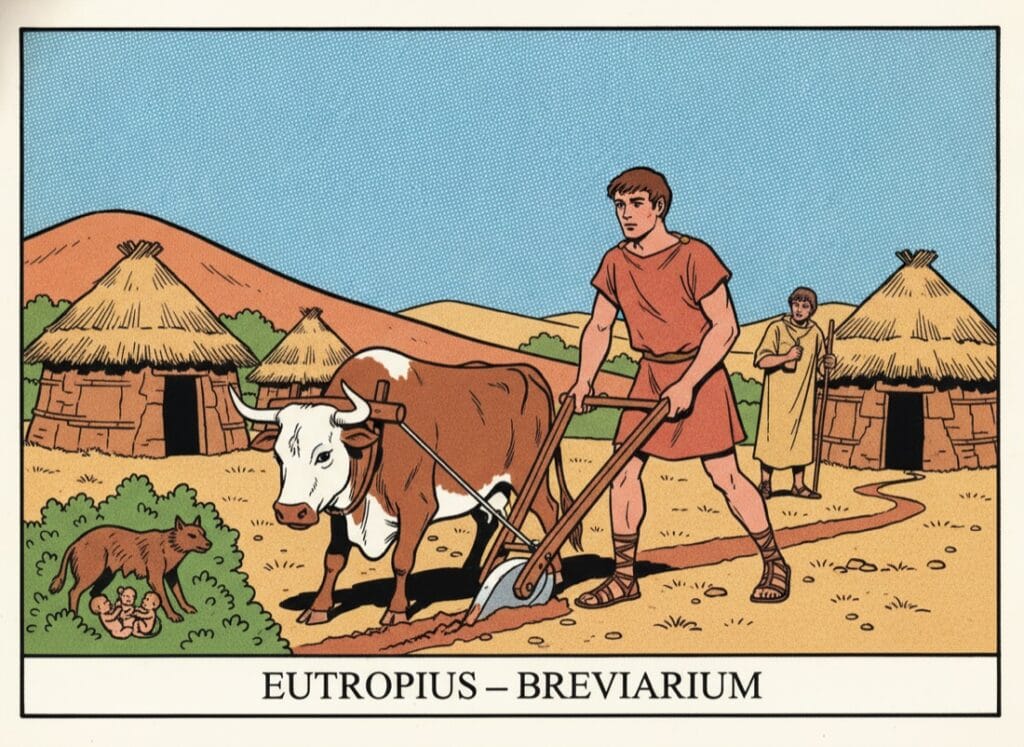
Right at the start of the Breviarium Eutropius tells of the founding of Rome by Romulus — in a single, clear sentence that shows why he is the ideal entry point:
Is cum inter pastores latrocinaretur, decem et octo annos natus urbem exiguam in Palatino monte constituit.
Eutropius, Breviarium 1,1
Our translation: “While he was living as a brigand among shepherds, at eighteen years old he founded a small city on the Palatine hill.” One main idea, one subordinate clause, one verb at the end — exactly the manageable structure that makes Eutropius the first original author.
You can check the Latin wording against free editions: The Latin Library and the biographical overview at Wikipedia.
In stages to the original — how the app grades the text
Reading research names a hard threshold: only when you know about 95% of the words in a paragraph do you read fluently. Eutropius is already the easiest real author — and even so the graded path helps: first a simplified version matched to your level, then the unchanged original. That makes the first leap from textbook to real Latin gentle, and forms and vocabulary are recycled in real sentence context.
In our in-app reader the Breviarium is built exactly this way — the same material across two stages:
| Stage | Collection in the app | Focus |
|---|---|---|
| stage L6 · simplified | Breviarium · Rhea Silvia, Romulus and Remus | The entry into real Latin |
| stage L24 · original | Breviarium 1,1–1,2 · the founding of Rome | Eutropius’ unchanged text |
The same passage, two stages — the founding of Rome
Here is what the path looks like. On the left the gently simplified version from “Breviarium · Rhea Silvia (stage L6)”; on the right Eutropius’ unchanged original (stage L24, Breviarium 1,1):
Simplified · stage L6
“Rhea Silvia erat virgo Vestalis. Rhea Silvia duos filios habebat. Filii Romulus et Remus erant.”
Rhea Silvia was a Vestal Virgin. Rhea Silvia had two sons. The sons were Romulus and Remus.
Original · stage L24 (Eutropius 1,1)
“Is cum inter pastores latrocinaretur, decem et octo annos natus urbem exiguam in Palatino monte constituit.”
While he was living as a brigand among shepherds, at eighteen years old he founded a small city on the Palatine hill.
The same content — only the difficulty grows: three short main clauses with erat/habebat against Eutropius’ original with a cum-clause in the subjunctive (latrocinaretur), the age phrase annos natus and the verb constituit at the end. Already manageable — and real Eutropius in context.
Key idea: the hardest text does not make you better — the one you understand at 95% does, and then one step higher. That is how the first leap into the original works.
Learn Latin now. Our learning app:

The Eutropius pitfalls — and how to crack them
Eutropius is easy — but not trap-free. Because he condenses centuries into a few pages, he compresses heavily. Three features are worth knowing:
1. Ablative-absolute chains
To tell a lot of history briefly, Eutropius uses the ablative absolute constantly: bello finito, hoc facto, urbe capta. Fail to resolve the ablative absolute reliably and you fail at Eutropius. Do not translate literally; work out the sense (temporal, causal …) — “when the war had ended.” See the ablative absolute.
2. Dates and numerals
Eutropius constantly names regnal years and dates — often by the consuls: L. Pisone et A. Gabinio consulibus = “in the consulship of L. Piso and A. Gabinius.” That is an ablative absolute without a participle. Practise resolving the ordinal and cardinal numbers, or the dating becomes a trap. Help: our Roman numeral converter.
3. The ellipsis of esse
In short, chronicle-like sentences the perfect/pluperfect passive very often drops est or sunt: Roma condita [est]. Rule of thumb: if there is only a perfect participle with no auxiliary, supply “is/was” or “was”.
| Pitfall | Signal | Most common mistake |
|---|---|---|
| Ablative-absolute chains | noun + participle in the ablative, often repeated | translated literally instead of by sense |
| Dates/numerals | consul names in the ablative, ordinals | dating not recognised as an ablative absolute |
| Ellipsis of esse | perfect participle with no auxiliary | est/sunt not supplied |
Frequently asked — Eutropius
Is Eutropius hard to translate?
No, Eutropius is considered the easiest real author: clear main clauses, little subordination. Just watch for the ablative-absolute chains, the dating by the consuls and the frequent ellipsis of esse.
Why is Eutropius read as the first original author?
Because his Breviarium is written deliberately plainly and paratactically. The leap from textbook into real, unaltered Latin is gentlest with Eutropius, which is why he usually stands at the very start of original reading.
What is the Breviarium ab urbe condita?
The Breviarium ab urbe condita is a ‘short summary’ of Roman history from the founding of Rome to the 4th century AD, written by Eutropius under the emperor Valens. It condenses centuries briefly and clearly.
From what level can I read Eutropius?
Simplified versions can be read towards the end of the middle years; the unchanged original works as a first real reading text, often at the transition to upper school.
Learn Latin now. Our learning app: