Latin Fifth Declension (e-Declension) — res, dies with Table

The fifth declension (e-declension) is the smallest of all. Only two words are really common — res (thing) and dies (day) — but they occur constantly, for instance in res publica (state) or res gestae (deeds). You recognise it by the running -e-. Part of the Learn Latin series.
- All endings of the fifth declension
- Tables for res and dies
- Why dies is masculine
- The special case res publica (both parts decline)
What is the fifth declension?
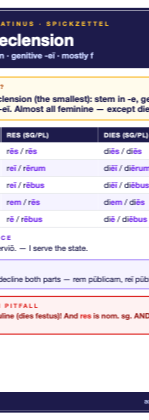
The fifth declension (e-declension) holds nouns with the stem vowel -e-. You recognise it by the genitive singular in -ei (res, rei). Almost all are feminine — the important exception is dies (day), which is masculine.
The endings of the fifth declension
| Case | Singular | Plural |
|---|---|---|
| Nominative | res | res |
| Genitive | rei | rerum |
| Dative | rei | rebus |
| Accusative | rem | res |
| Ablative | re | rebus |
How to spot it: the genitive singular in -ei (rei, diei). After a vowel the e is long (diēī), after a consonant short (rěī).

The tables: res and dies
res, rei f. — thing, matter
| Case | Singular | Plural |
|---|---|---|
| Nominative | res | res |
| Genitive | rei | rerum |
| Dative | rei | rebus |
| Accusative | rem | res |
| Ablative | re | rebus |
dies, diei m. — day
| Case | Singular | Plural |
|---|---|---|
| Nominative | dies | dies |
| Genitive | diei | dierum |
| Dative | diei | diebus |
| Accusative | diem | dies |
| Ablative | die | diebus |
Most other fifth-declension nouns (e.g. spes hope, fides faith) are used mainly in the singular. See the declension chart.
Learn Latin now. Our learning app:

Gender and the special case res publica
The fifth declension is feminine — with one exception: dies is masculine (“the day”), as is the compound meridies (“midday”). In the sense of “appointed date”, dies can also be feminine.
res publica (“the state”, literally “the public thing”) is a common pattern: both parts decline — rei publicae (gen./dat.), rem publicam (acc.), re publica (abl.). The adjective publica agrees with res.
The cases in a sentence
| Case | Latin | English |
|---|---|---|
| Nominative | Dies longus est. | The day is long. |
| Genitive | Fundamentum rei firmum est. | The basis of the matter is firm. |
| Dative | Rei publicae servio. | I serve the state. |
| Accusative | Rem gravem tractamus. | We deal with a serious matter. |
| Ablative | Die quinto advenit. | He arrived on the fifth day. |
Common mistakes
- Taking dies as feminine: normally dies is masculine — dies festus (the feast day), not dies festa.
- Confusing nom. sg. with the plural: res is at once nominative singular, nominative plural and accusative plural. The sentence decides.
- Only half-declining res publica: both words are inflected — genitive rei publicae, not res publicae.
- Narrowing the meaning of res: depending on context res means thing, matter, situation, circumstance, property or affair — not always “thing”.
Frequently asked questions
What is the fifth declension in Latin?
The fifth declension is the smallest one. Its nouns have the stem vowel -e-, above all res (thing) and dies (day). The genitive singular ends in -ei.
How do I recognise the fifth declension?
By the genitive singular in -ei, for example res, rei or dies, diei. No other declension has this ending.
Is the fifth declension feminine or masculine?
It is mostly feminine. The important exception is dies (day), which is masculine, as is meridies (midday).
How do you decline res publica?
Both parts decline: rei publicae (genitive and dative), rem publicam (accusative), re publica (ablative). The adjective publica agrees with res.
Which other words belong to the fifth declension?
Besides res and dies, mainly spes (hope), fides (faith), facies (face) and species (appearance) — these are used mostly in the singular.
Practise the declensions actively
Lapicida Latinus makes you type the forms instead of just ticking boxes — forms trainer, sentence quiz and reading in one app. Start free, full version from €19.99/year.
Learn Latin now. Our learning app: