Tertullian in Latin — Read the Apologeticum
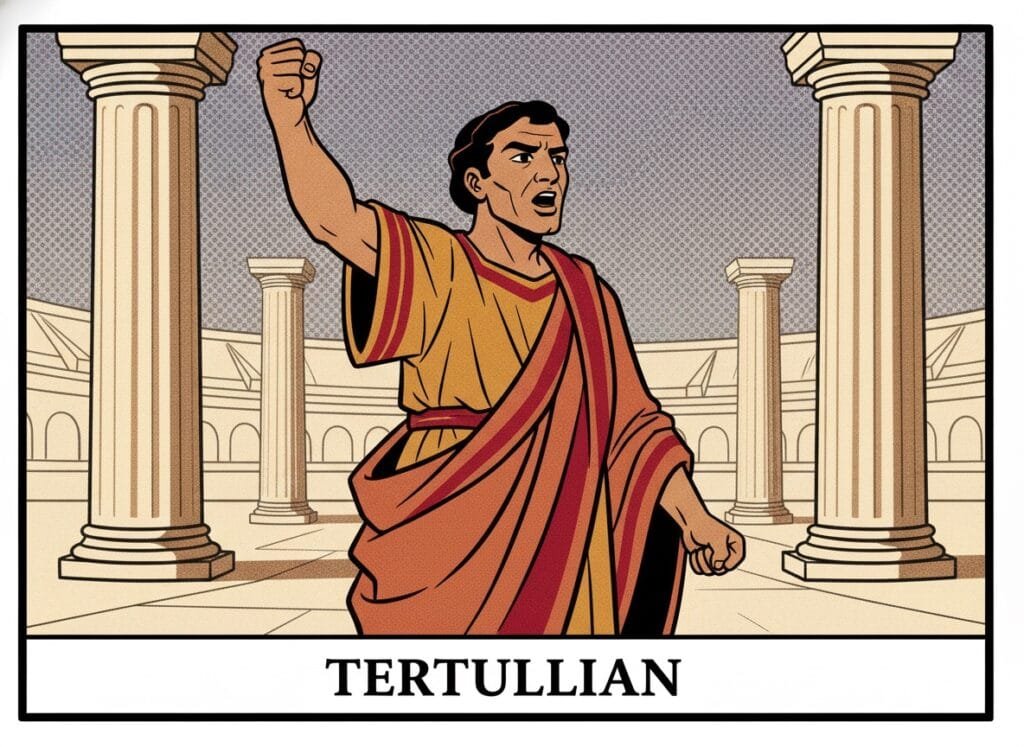
Tertullian (c. AD 155–220) of Carthage is the first great Christian writer in Latin and the father of Western theology. His Apologeticum is a fierce, brilliant defence of Christianity against the Roman state — and the source of the famous line “the blood of the Christians is seed.” That is where our idea comes in: read the same author in stages, from a gentler work to the original. This page belongs to our Learn Latin section and leads into our in-app reader.
Important: this is not a grab-bag of level sentences — you practise those in the Sentence Quiz. In the reader you get the real author as a connected text. Because context carries understanding — fragments never become reading.
- who Tertullian was — and why the Apologeticum is read in Latin
- the famous line on the martyrs in the original, with our own translation
- how the app grades the text from a gentler work to the original
- the typical Tertullian pitfalls — the ellipsis of esse, legal and sacred vocabulary
- common student mistakes and how to avoid them
Who was Tertullian?
Tertullian (c. AD 155–220), a Christian writer of Carthage trained in rhetoric and law, was the first to write Christian theology in Latin — and coined much of its vocabulary. His most important work, the Apologeticum, defends the Christians against persecution with legal precision and biting wit.
Tertullian’s line on the martyrs — in the original
The fiery close of the Apologeticum holds his most famous sentence:
Plures efficimur, quotiens metimur a vobis: semen est sanguis Christianorum.
Tertullian, Apologeticum 50
Our translation: “We grow in number as often as we are cut down by you: the blood of the Christians is seed.” The persecution meant to destroy the Church only makes it grow — a paradox often quoted as “the blood of the martyrs is the seed of the Church.”
You can check the Latin against free editions: The Latin Library (Apologeticum), the English at New Advent, and the overview at Wikipedia.
In stages to the original — how the app grades the text
Reading research names a hard threshold: only when you know about 95% of the words in a paragraph do you read fluently. Tertullian’s terse, allusive style makes that hard. So we read him in stages, from a gentler work up to the original.
In our in-app reader Tertullian is built as a ladder:
| Stage | Collection in the app | Focus |
|---|---|---|
| stage L12 | De patientia 1–5 · adapted | A gentler entry |
| stage L18 | Apologeticum 39–40 | The Christian community |
| stage L21 | Apologeticum 50 (original) | Semen est sanguis |
From a gentler work to the original — two ends of the ladder
On the left the gentler entry from “De patientia (stage L12)”, on the right Tertullian’s original from “Apologeticum 50 (stage L21)”:
Entry · stage L12 (De patientia)
“Confiteor me ad hoc opus parum idoneum esse.”
I confess that I am hardly fit for this work.
Original · stage L21 (Apologeticum 50)
“Plures efficimur, quotiens metimur a vobis: semen est sanguis Christianorum.”
We grow more numerous every time we are cut down by you: the blood of the Christians is seed.
Real Tertullian both times — only the difficulty grows: the clear confession with an ACI (me … idoneum esse) against the compressed original, where est is delayed and the metaphor semen … sanguis is packed tight.
Key idea: the hardest text does not make you better — the one you understand at 95% does, and then one step higher.
Learn Latin now. Our learning app:

The Tertullian pitfalls — and how to crack them
Tertullian writes in the heated, compressed style of Carthaginian rhetoric. Three features cost the most marks:
1. The ellipsis of esse
Tertullian very often drops the auxiliary esse: Quid ergo mirum [est] … Students hunt in vain for a verb. If a sentence seems to have no predicate, supply “is” or “are” at once.
2. Legal and sacred vocabulary
As a rhetorician and lawyer, Tertullian fills old words with new meaning: disciplina is not “discipline” but the Christian teaching / way of life; sacramentum is not the military oath but the bond with God / creed.
3. Compressed, colloquial syntax
Constructions like esse in causam (“to be the cause”) and the abrupt cries of the crowd (Christianos ad leonem! “the Christians to the lion!”) depart from classical Cicero. Read for sense, not word by word.
| Pitfall | Signal | Most common mistake |
|---|---|---|
| Ellipsis of esse | sentence with no visible verb | hunting for a verb instead of supplying est |
| Sacred vocabulary | disciplina, sacramentum | classical meaning taken |
| Compressed syntax | esse in causam, sudden cries | read literally word by word |
Frequently asked — Tertullian
What does ‘the blood of the martyrs is the seed’ mean?
It is Tertullian’s line ‘semen est sanguis Christianorum’ (Apologeticum 50): the persecution meant to destroy the Church only makes it grow. It is often quoted as ‘the blood of the martyrs is the seed of the Church’.
Who was Tertullian?
A Christian writer of Carthage (c. AD 155-220), trained in rhetoric and law. He was the first to write Christian theology in Latin and coined much of its vocabulary; his chief work is the Apologeticum.
Is Tertullian hard to translate?
Yes — his heated, compressed style is challenging. Watch the frequent ellipsis of esse, the legal and sacred vocabulary (sacramentum, disciplina), and the colloquial syntax. Read in stages and it becomes manageable.
What is the Apologeticum?
Tertullian’s most important work: a legal defence of Christianity, written around AD 197, answering the charges brought against Christians by the Roman state.
Learn Latin now. Our learning app: