Augustine in Latin — Read & Translate the Confessions
Augustine (Aurelius Augustinus of Hippo, AD 354–430) is the most important Latin Church Father — and, with his Confessions (Confessiones), one of the most widely read authors in theological upper-school and exam reading. The Confessions are the first great self-portrait in world literature: the story of a search, the famous conversion in the garden at Milan, the wrestling with God. The appeal: a surprisingly modern, personal voice. The hurdle: Augustine’s late-antique, Bible-soaked Latin. That is exactly where our idea comes in: read the same text in stages — from a gently simplified version matched to your level up to the verbatim original. This page belongs to our Learn Latin section and leads straight into our in-app reader.
Important: this is not a grab-bag of level sentences — you practise those in the Sentence Quiz. In the reader you get the real Augustine as a connected text. Because context carries understanding — fragments never become reading.
- Who Augustine was — and why the Confessions are a classic school author
- The famous opening sentence of the Confessions in the original, with our own translation
- How the app grades the conversion scene from simplified to the original
- The typical Augustine pitfalls — quod-clauses, Christian vocabulary, metaphor
- Common student mistakes and how to avoid them
Who was Augustine?
Aurelius Augustinus (AD 354–430), bishop of Hippo in North Africa, was the most influential theologian and philosopher of the Latin late antiquity. His thought shapes Western Christianity to this day; his masterwork, the Confessions (c. AD 400), unites autobiography, prayer and philosophical reflection. For the classroom, Augustine is the key author of Church Latin: personal, lyrical, steeped in Scripture — a different register from classical Cicero, but no less a summit of Latin prose.
The opening of the Confessions — in the original
The very first paragraph of the Confessions holds Augustine’s most famous sentence — the programme of the whole work in a single image:
Fecisti nos ad te, et inquietum est cor nostrum, donec requiescat in te.
Augustine, Confessions 1,1
Our translation: “You have made us for yourself, and our heart is restless until it rests in you.” In one sentence stands the whole movement of the Confessions: the restlessness of the human heart and its goal. Equally famous is the conversion scene in Book 8, where a child’s voice sings “Tolle, lege” (“Take up and read!”).
You can check the Latin wording against free editions: The Latin Library, the annotated context at the Stanford Encyclopedia of Philosophy, and the overview at Wikipedia.
In stages to the original — how the app grades the text
Reading research names a hard threshold: only when you know about 95% of the words in a paragraph do you read fluently. Jump straight from the textbook into Augustine’s periods and those 95% are almost always missing — vocabulary, late-antique syntax and theological thought arrive at once. So we read the same Augustine material in stages: first a simplified version matched to your level, then steadily harder — up to the unchanged original. The cognitive load is shared, and forms and vocabulary are recycled again and again in real sentence context.
In our in-app reader the conversion scene is built exactly this way — the same passage across several stages:
| Stage | Collection in the app | Focus |
|---|---|---|
| stage L18 · simplified | Confessions 8,12 · in the garden | The conversion, untangled |
| stage L21 | Confessions 1,1 · adapted | Inquietum cor — the restless heart |
| stage L24 · original | Confessions 8,12,29 · Tolle, lege | Augustine’s unchanged text |
The same scene, two stages — Tolle, lege
Here is what the path looks like. On the left the gently simplified version from “Confessions 8,12 (stage L18)”; on the right Augustine’s unchanged original (stage L24, Conf. 8,12,29):
Simplified · stage L18
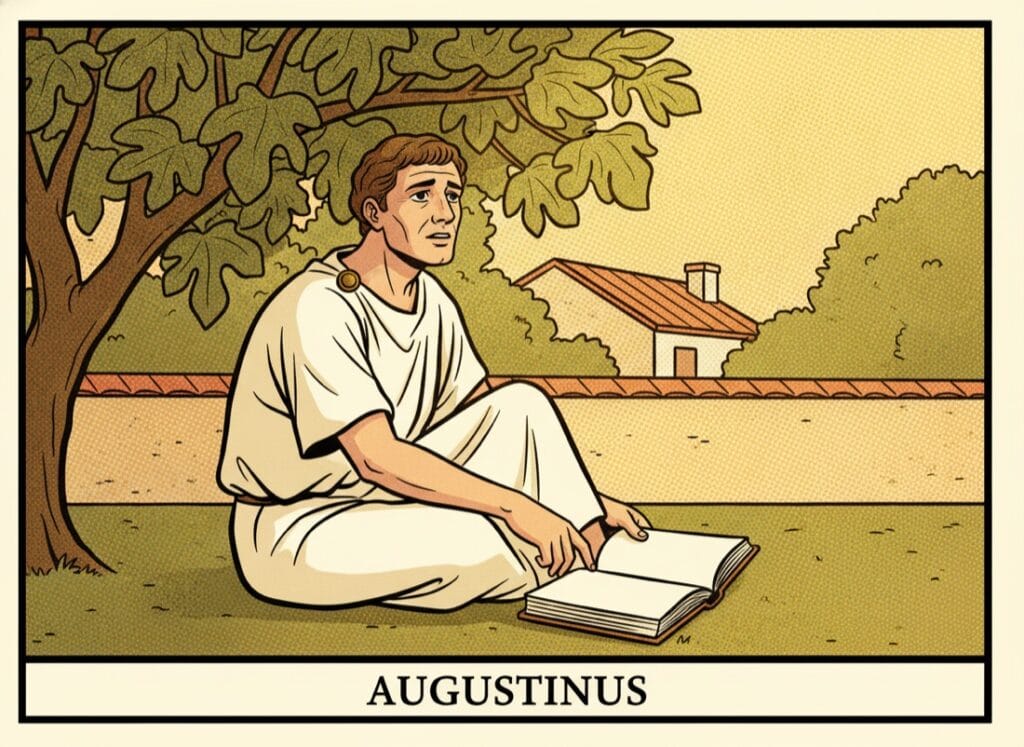
“Ego sub quadam fico stravi me et dimisi habenas lacrimis.”
I threw myself down under a fig tree and gave free rein to my tears.
Original · stage L24 (Conf. 8,12,29)
“Et ecce audio vocem de vicina domo cum cantu dicentis et crebro repetentis: Tolle, lege; tolle, lege.”
And behold, I hear a voice from a neighbouring house, singing and constantly repeating: Take up and read; take up and read.
The same conversion scene — only the difficulty grows: the plain main clause against Augustine’s original with its participial frame (dicentis et crebro repetentis) and the vivid present audio in the middle of the narrative. Both times real Augustine in context, not isolated sentences.
Key idea: the hardest text does not make you better — the one you understand at 95% does, and then one step higher. That is how you reach the original safely.
Learn Latin now. Our learning app:

The Augustine pitfalls — and how to crack them
Augustine writes late-antique, Bible-shaped Latin. Three features cost the most marks. One example each:
1. The quod-clause instead of ACI
Where a classical author uses an accusative-and-infinitive, Augustine often writes a clause with quod, quia or quoniam after verbs of saying, perceiving and believing: credo quod venisti for credo te venisse. Resolve this content clause like an ordinary “that”-clause in English — not literally with “because.”
2. The Christian vocabulary
Classical words shift meaning in Augustine: iniquitas is not merely “injustice” but “sin”; caro (flesh) means the “body / human nature” as opposed to the spirit; verbum can be the divine “Word.” Check the theological context, not the classical base meaning.
3. The dense metaphor
Augustine’s style is highly emotional and image-rich. Phrases like dimittere habenas lacrimis (“to let the reins go to one’s tears” = to give free rein) or flumina oculorum (“rivers of the eyes” = floods of tears) must not be rendered woodenly word for word, but carried across as an image.
| Pitfall | Signal | Most common mistake |
|---|---|---|
| quod-clause for ACI | quod/quia/quoniam after a verb of saying | translated with “because” instead of “that” |
| Christian vocabulary | iniquitas, caro, verbum | classical base meaning taken |
| Metaphor | an image-laden phrase | rendered woodenly instead of by sense |
Frequently asked — Augustine
Is Augustine hard to translate?
Augustine’s Latin is late-antique and Bible-shaped. The main difficulties are the quod-clauses instead of ACI, the shifted Christian vocabulary (iniquitas = sin) and the dense metaphor. Learn these patterns and read in stages, and you will manage well.
From what level can I read Augustine?
Simplified versions of the conversion scene can be read from the third or fourth year. The unchanged original of the Confessions is typical upper-school and exam level.
What does Tolle, lege mean?
Tolle, lege means ‘Take up and read!’. In the Confessions (8,12) Augustine hears a child’s voice in the garden at Milan singing these words, opens the Bible and experiences his conversion. It is one of the most famous scenes in world literature.
What are the Confessions?
The Confessions (Confessiones, c. AD 400) are Augustine’s autobiographical masterwork: the story of his path to God, at once prayer and philosophical reflection. They are regarded as the first great self-portrait in Western literature.
Learn Latin now. Our learning app: