Learn Latin Effectively — The Cognitive-Load Trick Textbooks Miss
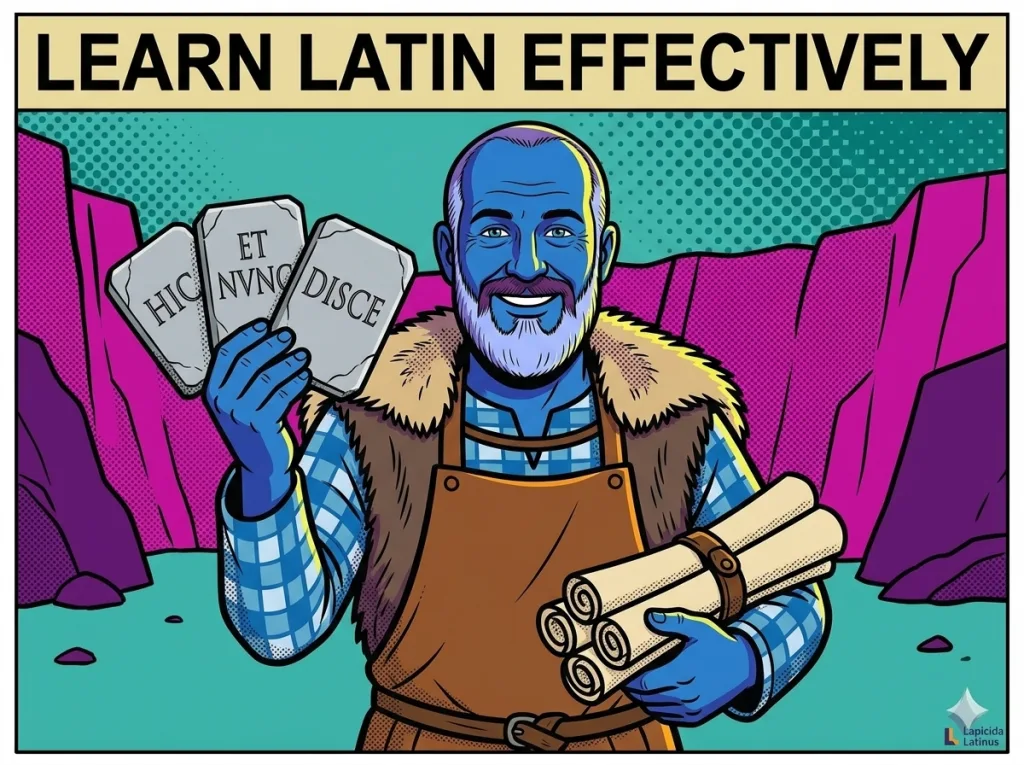
Why is Latin so hard — when all you “have to do” is learn a few endings? Cognitive Load Theory (CLT), formulated by John Sweller in 1988, gives a precise answer: working memory is limited. When too much information has to be processed at once, learning collapses. To learn Latin effectively, then, means one thing above all: reduce cognitive load, don’t pile it on.
- Three kinds of load: intrinsic (how hard the material really is), extraneous (poor design), germane (the learning itself)
- Working memory holds roughly 4 elements at once — that’s the ceiling
- The split-attention effect: a table on one page, its explanation on another, doubles the load
- How Lapicida Latinus builds CLT into every module
What is Cognitive Load Theory?
Cognitive Load Theory (CLT) explains why some learning designs work far better than others. Working memory can process only about four elements of information at the same time (Miller, 1956; Cowan, 2001). Exceed that capacity and learning fails — not because the learner isn’t trying hard enough, but because the design asks for too much at once.
Learn Latin now. Our learning app:

| Type of load | Where it comes from | What design can do |
|---|---|---|
| Intrinsic load | the inherent complexity of the material | can be reduced by sequencing |
| Extraneous load | distractions, poor UI, split attention | should be minimised — this is the main job of good learning design |
| Germane load | the effort of actual learning (building schemas) | should be maximised — this is the effort that pays off |
Intrinsic, extraneous and germane load in Latin
Intrinsic load in Latin is unavoidable: the dative plural of the consonant declension, the tense relationships inside an accusative-and-infinitive (AcI), and the four senses of cum are objectively complex. But design can lower this load through sequencing — first the a/o-declension, then the consonant declension. Not everything at once.
Extraneous load is what bad learning adds on top: the table on page 42, the explanation on page 43, the exercise on page 45 — three sources you have to hold in your head simultaneously. That is the split-attention effect. Good design integrates information and practice into a single step.
Germane load is the load of real learning: actively retrieving, forming new schemas, abstracting rules. This effort is the good kind — it is what consolidates long-term memory. Active recall (Roediger & Karpicke, 2006) is one of the most reliable ways to maximise germane load.
Cognitive Load Theory in Lapicida — concrete design decisions
| Module | CLT problem (extraneous) | Lapicida’s answer |
|---|---|---|
| Forms trainer | memorising tables in isolation = split attention | identify the ending inside a real sentence — the full paradigm appears only on request (paradigm button) |
| Vocabulary trainer | ten new words at once = overload | Box 0: one word, flip mode, then a hint — a progressive build-up |
| Sentence quiz | sentences too hard = frustration instead of learning | 14 areas, easy to hard, each locked until the previous one is secure |
| Reading | an original text with no support = cognitive overload | vocabulary help on demand, XML-annotated sentence parts, word-form hints available |
The worked-example effect: beginners gain more from fully worked examples than from unguided practice (Sweller & Cooper, 1985). The first time a new construction appears, Lapicida shows an explanatory overlay automatically.
Learn Latin effectively — with design that respects your brain
Lapicida cuts extraneous load and maximises germane load — so you make faster progress with less frustration.
Learn Latin effectively — tips without an app
- Sequence, don’t overwhelm: one declension pattern a day, not all five at once. Working memory needs time to build schemas.
- Avoid split attention: never keep the table and the exercise on different pages. Always practise an ending in context, not in isolation.
- Worked examples first: show new material fully explained and solved, then set the exercises — not the other way round.
- The expertise-reversal effect: what helps beginners (lots of explanation) gets in the way of the more advanced. Hide the explanations once a form is secure.
Frequently asked — learning Latin effectively
What is Cognitive Load Theory?
Cognitive Load Theory (CLT) is an educational theory by John Sweller (1988) describing how working memory is taxed during learning. Working memory holds about four elements at a time. Good learning design minimises extraneous load (poor UI, split attention) and maximises germane load (genuine learning).
Why is Latin so cognitively demanding?
Latin carries high intrinsic load: an ending system of five declensions × six cases × two numbers = over 60 forms, plus verb conjugation, participles, the AcI, the ablative absolute and tense relationships. Each layer taxes working memory. Effective learning sequences these layers and automates each one before the next is added.
What is the split-attention effect?
The split-attention effect occurs when related pieces of information are separated in space or time — for example a grammar table on page 42 and the practice sentence on page 45. Working memory has to hold both sources at once, which creates extraneous load. The fix: integrate information and practice.
Learn Latin effectively — start now
Learning design grounded in CLT: forms trainer, sentence quiz and vocabulary trainer with progressive difficulty and minimised extraneous load. Start for free.
About the author
Andreas Blankenstein is the founder of Lapicida Latinus — and dyslexic himself. When he had to earn the Latinum in record time, one thing became clear: endless table-cramming fails precisely the people who learn differently. That is why Lapicida builds learning around real author texts, colour-coded and in short steps. More about Andreas and the Lapicida method →
Spaced repetition — how review intervals decide what sticks · Active recall — the testing effect explained · Latin with dyslexia — a learner-friendly app
Learn Latin now. Our learning app: