Seneca in Latin — Read & Translate the Moral Letters
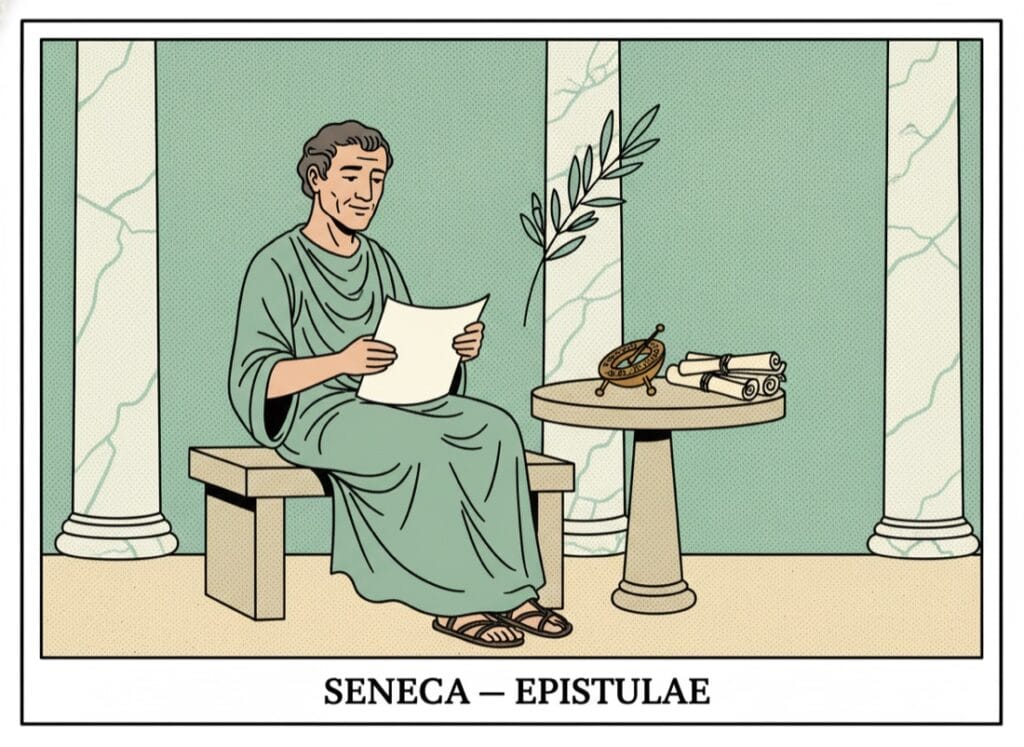
Seneca (Lucius Annaeus Seneca, c. 4 BC–AD 65) is the most important Stoic philosopher of Roman literature — and one of the most widely read authors in upper school and on the road to real original reading. In class you meet him above all in the Epistulae morales ad Lucilium, his “moral letters” to his friend Lucilius: short, pointed lessons on time, the crowd and how to treat enslaved people. The appeal: thoughts that still land after 2,000 years. The hurdle: Seneca’s terse, elliptical style, where the key word is often left unsaid. That is exactly where our idea comes in: read the same author in stages — from a gently simplified version matched to your level up to the verbatim original. This page belongs to our Learn Latin section and leads straight into our in-app reader.
Important: this is not a grab-bag of level sentences — you practise those in the Sentence Quiz. In the reader you get the real Seneca as a connected letter, following the Stoic argument. Because context carries understanding — fragments never become reading.
- Who Seneca was — and why the Epistulae morales are the classic Stoic school text
- Seneca’s most famous line on enslaved people in the original, with our own translation
- How the app grades Seneca from a simplified version to the original
- The typical Seneca pitfalls — the ellipsis of esse, immo, and the Stoic paradox of freedom
- Common student mistakes and how to avoid them
Who was Seneca?
Lucius Annaeus Seneca (c. 4 BC–AD 65), known as Seneca the Younger, was a Stoic philosopher, dramatist and tutor — for a time the most powerful adviser at the court of the emperor Nero, who finally forced him to take his own life in AD 65. He is famous for the Epistulae morales ad Lucilium, 124 letters on the art of living well. For the classroom, Seneca is the central author of Stoicism: modern in thought, pointed in style and, thanks to short sentences, deceptively easy — until the famous ellipses and paradoxes appear.
Seneca’s most famous line — from the letter on slaves (Ep. 47)
In the 47th letter Seneca calls for a humane treatment of enslaved people — a radical idea for antiquity. The core stands in three short words:
Servi sunt. Immo homines.
Seneca, Epistulae morales 47
Our translation: “They are slaves? No — they are human beings.” With the tiny word immo Seneca corrects the common view of his time and places master and slave on the same human footing. That force makes the sentence one of the most famous quotations in ancient ethics — and a classic of the reading list.
You can check the Latin wording and the author against free, scholarly sources: the Stanford Encyclopedia of Philosophy (Seneca), the original text of the letters at The Latin Library, and the biographical overview at Wikipedia.
In stages to the original — how the app grades the text
Reading research names a hard threshold: only when you know about 95% of the words in a paragraph do you read fluently. With Seneca the short sentence deceives — it looks easy but demands a lot of understood grammar and a Stoic idea. So we read Seneca in stages: first simplified, Seneca-near letters matched to your level, then steadily harder — up to the unchanged original. The cognitive load is shared, and forms and vocabulary are recycled again and again in real letter context.
In our in-app reader Seneca is built as a ladder of real letters — from a simplified start to the original:
| Stage | Letter in the app | Theme |
|---|---|---|
| stage L21 · simplified | Epistle 1 · On time | Vindica te tibi — claim yourself for yourself |
| stage L24 · simplified | Epistle 7 · The crowd | Why the masses harm your character |
| stage L27 · original | Epistle 47 · On slaves | Servi sunt. Immo homines. — Seneca’s humanity |
From the entry to the original — the two ends of the ladder
Here is what the path looks like. On the left the simplified entry from “Epistle 1 · On time (stage L21)”; on the right the unchanged original from “Epistle 47 · On slaves (stage L27)” — two real letters of Seneca at the ends of the ladder:
Entry · stage L21 (Ep. 1)
“Ita fac, mi Lucili: vindica te tibi. Collige omne tempus et serva.”
Do so, my Lucilius: claim yourself for yourself. Gather up all your time and keep it.
Original · stage L27 (Ep. 47)
“Servi sunt. Immo homines. Immo conservi, si cogitaveris tantundem in utrosque licere fortunae.”
They are slaves? No — human beings. No — fellow slaves, if you consider that fortune has the same power over both.
Real Seneca both times — only the difficulty grows. With Seneca the hurdle is not sentence length but what you must supply: the omitted verb (homines [sunt]), the sharpening immo and the subjunctive in the conditional clause (si cogitaveris). That is exactly what the simplified stages prepare you for.
Key idea: the hardest text does not make you better — the one you understand at 95% does, and then one step higher. That is how you reach the original safely.
Learn Latin now. Our learning app:

The Seneca pitfalls — and how to crack them
Seneca writes short and pointed — which feigns ease. Three features cost students the most marks in exams. One example each:
1. The ellipsis of esse
Seneca saves ink: he often drops the verb est or sunt. Servi sunt. Immo homines. — in the second sentence sunt must be supplied: “No, they are human beings.” Hunting desperately for a verb wastes time. Rule of thumb: if the verb is missing, supply “is” or “are” in your head at once.
2. The little word immo
immo is a key word in Seneca’s reasoning — and, because of the similar sound, is often confused with semper (“always”). immo means “no, rather” or “indeed, even” and drastically corrects the previous statement: Servi sunt. Immo homines. = “Slaves? No, rather human beings.”
3. The Stoic paradox of freedom
Seneca writes that a master too can be a slave: alius libidini servit, alius avaritiae — “one is a slave to lust, another to greed.” Translate that purely physically and the apparent contradiction puzzles you. He means inner, mental freedom: for a Stoic, anyone ruled by their impulses is a slave. Here servire takes the dative in a figurative sense.
| Pitfall | Signal | Most common mistake |
|---|---|---|
| Ellipsis of esse | sentence with no visible verb | desperate verb-hunt instead of supplying est/sunt |
| immo | immo at the start of a sentence | confused with semper (“always”) |
| Paradox of freedom | servire + dative, figurative | translated physically instead of mentally |
Frequently asked — Seneca
Is Seneca hard to translate?
Seneca’s sentences are short and look easy — the hurdle is what you must supply: the ellipsis of esse, the sharpening immo and the Stoic idea. Learn these features and read in stages, and you will manage well.
From what level can I read Seneca?
Simplified letters (such as Epistle 1 on time) can be read towards the end of the middle years. The unchanged original of the Epistulae morales is typical upper-school and exam level.
Which letters of Seneca are read in school?
The core canon includes Epistle 1 (on time, “vindica te tibi”), Epistle 7 (on the danger of the crowd) and Epistle 47 (on the humane treatment of slaves, “servi sunt, immo homines”).
What is Stoicism in Seneca?
Stoicism is the philosophy of inner freedom: whoever is not ruled by impulses and passions is free — even as a slave. Seneca makes this teaching vivid in the Epistulae morales through concrete situations of everyday life.
Learn Latin now. Our learning app: