
ACI Latin Explained Simply — With Examples and Exercises

The Latin ACI—also known as the accusative with the infinitive—is one of the most important Latin constructions and, for many students, one of the most difficult hurdles to overcome. Yet the Latin ACI follows a clear pattern that, once you understand it, you’ll be able to recognize with confidence.
In this article, you’ll learn: what the ACI is, how to identify it in 5 steps, how to translate it—and how to use pronouns (se vs. eum/eam/id) correctly. How systematic practice with Lapicida works: The Lapicida Learning Method.

What Is the ACI in Latin? (Accusative with Infinitive)
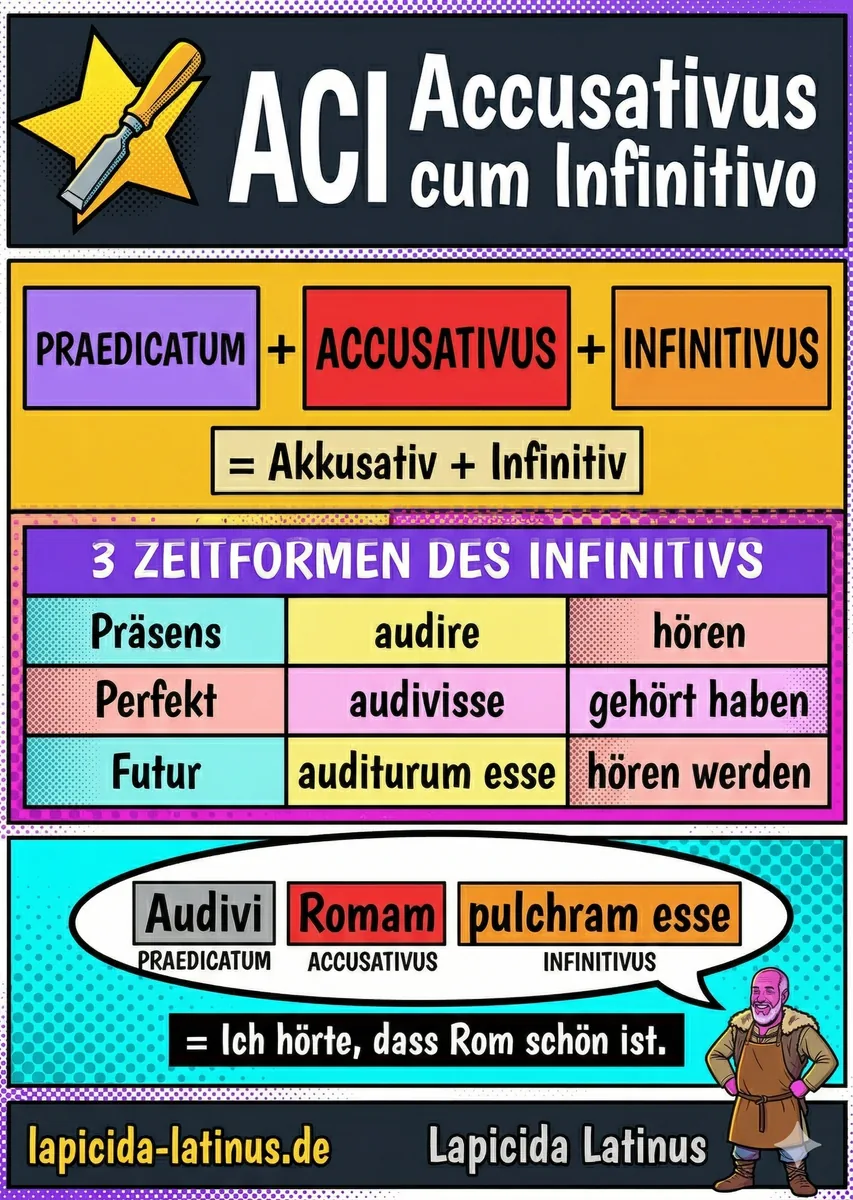
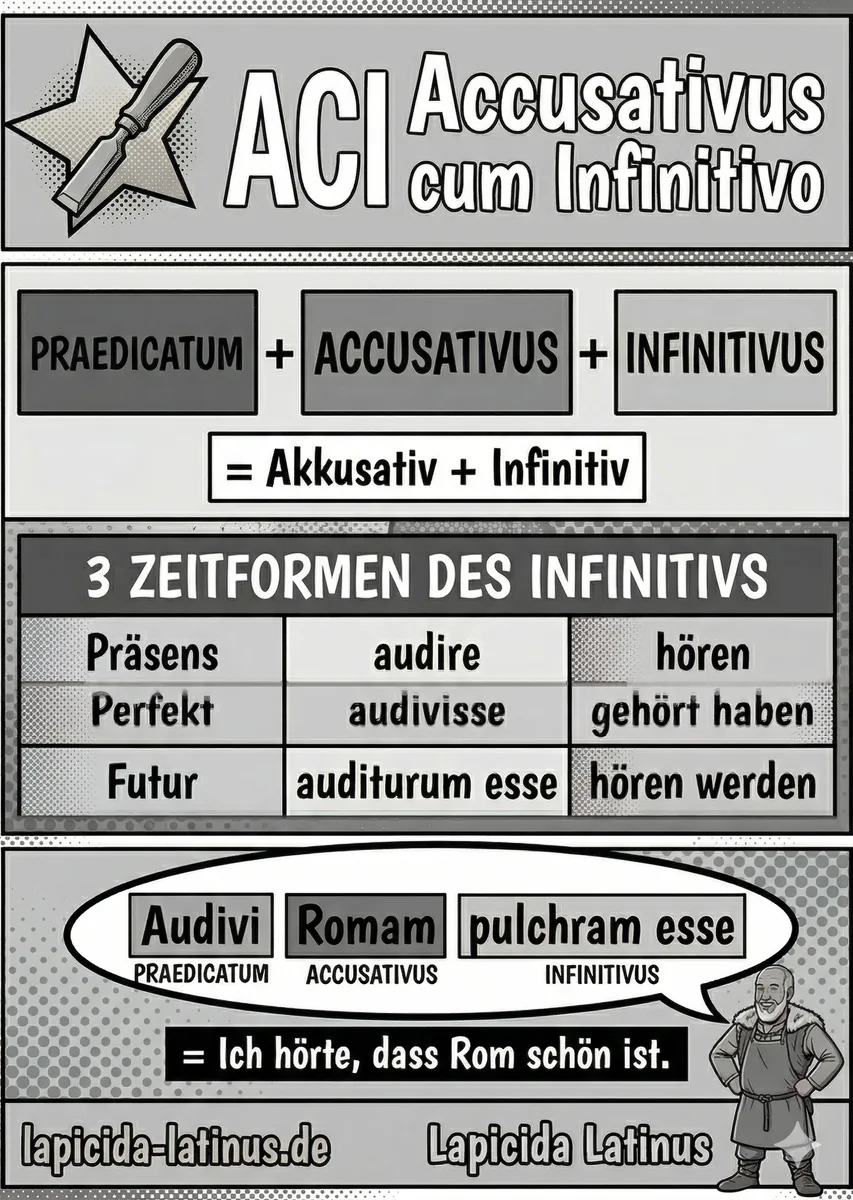
The accusative with infinitive (ACI) is a Latin sentence structure in which the subject of the subordinate clause is in the accusative case and the predicate appears as an infinitive—instead of a normal “that” clause.
| Sentence element | Form in German | Form in Latin |
|---|---|---|
| Main predicate | Verb of saying/thinking (e.g., to hear) | audire, dicere, putare … |
| ACI subject | Subject of the “that” clause | Accusative |
| ACI predicate | Verb of the “dass” clause | Infinitive (present/perfect/future) |
Mnemonic: The Latin ACI replaces the German “dass” clause: The subject is in the accusative, and the verb is in the infinitive.
Recognizing the Latin ACI — in 5 steps
Step 1: Find the main verb
Look for a verb expressing saying, thinking, perceiving, or knowing: audire (to hear), dicere (to say), putare (to think), scire (to know), videre (to see), sperare (to hope).
Step 2: Look for the accusative
The subject of the subordinate clause is in the accusative—not the nominative. Example: *Romam* (accusative of *Roma*) instead of *Roma*.
Step 3: Identify the infinitive
The predicate is in the infinitive form: present infinitive (esse), perfect infinitive (fuisse), or future infinitive (futuram esse). The ending indicates when the action takes place.
Step 4: Determine the temporal relationship
Present infinitive = at the same time as the main clause. Perfect infinitive = earlier than the main clause. Future infinitive = later than the main clause.
Step 5: Translate
Translate the ACI using a German “dass” clause. The accusative object becomes the subject of the subordinate clause (nominative), and the infinitive becomes the conjugated verb.

Latin ACI Examples — Three Sentences, One Theme
All three examples are based on the same principle: Audivi / Spero — Romam pulchram esse / fuisse / futuram esse. Only the infinitive changes—and with it, the temporal relationship.
| Latin Sentence | Infinitive | Temporal Relationship | English Translation |
|---|---|---|---|
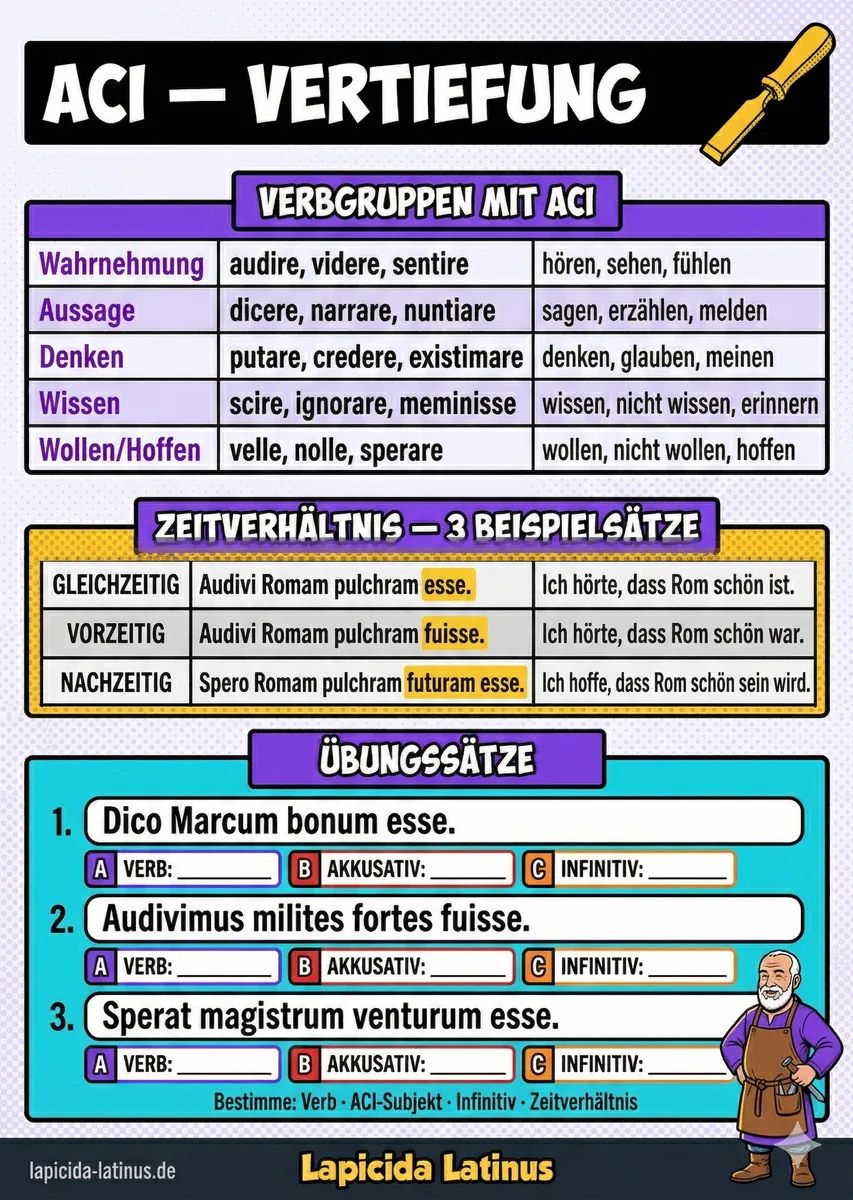
| Audivi Romam pulchram esse. | Present infinitive of “esse” | at the same time | I heard that Rome is beautiful. |
| Audivi Romam pulchram fuisse. | Infinitive perfect: fuisse | in the past perfect | I have heard that Rome was beautiful. |
| Spero Romam pulchram futuram esse. | Future infinitive: futuram esse | in the future | I hope Rome will be beautiful. |
Example 1: Present infinitive — simultaneously
Audivi Romam pulchram esse. — “I have heard that Rome is beautiful.”
Structure: Audivi = main verb (to hear, perfect tense). Romam = ACI subject in the accusative. pulchram = predicate adjective, agrees with Romam (accusative). esse = present infinitive. Rome’s beauty is considered to exist at the same time as the act of hearing.
Example 2: Perfect infinitive — in the past
Audivi Romam pulchram fuisse. — “I have heard that Rome was beautiful.”
Structure: Same structure as Example 1—only fuisse instead of esse. The perfect infinitive indicates that Rome’s beauty preceded the moment of hearing. Classically used in historical accounts.
Example 3: Future infinitive — after the time of hearing
Spero Romam pulchram futuram esse. — “I hope that Rome will be beautiful.”
Structure: Spero = to hope (verb of expectation). Romam = ACI subject. futuram esse = active future infinitive (acc.: futuram because Romam is feminine). Beauty lies in the future. Future infinitive = future participle + esse.
Understand Latin instead of cramming — try it right now.

Which verbs are used with the Latin ACI?
The Latin ACI occurs only after certain superordinate verbs:
| Verb group | Latin verbs | English Meaning |
|---|---|---|
| Verba sentiendi (perception) | audire, videre, sentire | to hear, to see, to feel |
| Verba declarandi (statement) | dicere, narrare, nuntiare | to say, to tell, to report |
| Verbs of thought/belief | putare, credere, existimare | to think, to believe, to suppose |
| Verbs of knowing (knowing) | scire, ignorare, meminisse | to know, to not know, to remember |
| Verbs of volition/emotion | velle, nolle, gaudere, sperare | to want, to not want, to be glad, to hope |
All stem forms of ACI verbs for reference: Navigium Latin Dictionary — instantly shows which verb group and whether ACI is possible.

Pronouns in the ACI — se or eum/eam/id?
In the ACI, you must distinguish: If the subject of the ACI clause is the same person as the subject of the main clause, the reflexive pronoun se (accusative) must be used. If it is a different person, use eum, eam, or id.
| Situation | Pronoun | Latin sentence | Translation |
|---|---|---|---|
| Same subject | se | Caesar dicit se Romam amavisse. | Caesar says that he himself loved Rome. |
| Different subject | eum / eam / id | Caesar dicit eum Romam amavisse. | Caesar says that [someone else] loved Rome. |
Mnemonic: Same = se, Different = eum — the shortest way through the most common pronoun trap in the ACI. The same principle applies to possessive pronouns: suus (reflexive, one’s own subject) vs. eius (non-reflexive, someone else).
In the Sentence Quiz Section 5 (ACI), starting with Lesson 17, you’ll practice this exact distinction using real Latin sentences—you’ll mark “se” or “eum” directly as the accusative subject of the ACI.
Common Mistakes with the ACI in Latin
- Nominative instead of accusative: The ACI subject is in the accusative. Roma (nom.) → incorrect; Romam (acc.) → correct.
- Incorrect tense: Always align the infinitive with the tense of the main clause. fuisse = was (past tense in the subordinate clause).
- Omitting the predicate adjective: *pulchram* agrees with the ACI subject (accusative, feminine) — it is part of the predicate, not an attribute.
- Forgot the future infinitive: *futurus/a/um esse* is the most common future form in ACI. The future participle agrees in case, gender, and number with the accusative object.
Latin ACI Infinitive — Present, Perfect, and Future
In the ACI, the infinitive appears in one of three tenses—present (simultaneity), perfect (past), and future (future). The infinitive is not determined by the subject clause, but by the accusative subject in the ACI (gender, number, case):
| Infinitive Type | Formation | Example (amare) | Meaning in the ACI |
|---|---|---|---|
| Present Active | Present stem + -re | amare | that he loves (simultaneously) |
| Present passive | Present stem + -rī | amari | that he is loved |
| Active perfect | Perfect stem + -isse | amāvisse | that he has loved (prematurely) |
| Perfect Passive | PPP (acc.) + esse | amātum esse | that he had been loved |
| Future Active | PFA (acc.) + esse | amātūrum esse | that he will love (in the future) |
| Future Passive | Supine I + īrī | amātum īrī | that he will be loved |
What is “futuram esse”? It is the active future infinitive of esse (to be). The future participle of esse is futūrus, -a, -um. In ACI, it agrees with the accusative subject: Spero Romam pulchram futuram esse — “I hope that Rome will be beautiful.” (futuram = acc. sing. f., because Romam is feminine). Alternative: “fore” is an uninflected short form of “futurum/am/um esse”—classical and frequently used by Caesar and Cicero.
Important for the perfect and future passive: the past perfect passive (PPP) and future perfect active (PFA) agree in gender and number with the accusative subject—but the first supine (amātum īrī) remains completely unchanged. Note: laudātum īrī remains the same regardless of whether the subject is masculine, feminine, or plural.
Practice ACI Latin — 4 practice sentences
Identify the following for each sentence: main verb, ACI subject, infinitive, and temporal relationship. Then translate.
Exercise 1: Dico Marcum bonum esse.
Solution: Verb: dico (to say). Subject: Marcum (acc.). Present infinitive: esse. Temporal relationship: simultaneously. Translation: I say that Marcus is good.
Exercise 2: Audivimus milites fortes fuisse.
Solution: Verb: audivimus (we heard). Subject: milites (acc. pl.). Perf. infin.: fuisse. Temporal relationship: in the past. Translation: We heard that the soldiers were brave.
Exercise 3: Sperat magistrum venturum esse.
Solution: Verb: sperat (he/she hopes). Subject: magistrum (accusative). Future infinitive: venturum esse. Tense: future. Translation: He/she hopes that the teacher will come.
Exercise 4: Audivi Romam pulchram fuisse.
Solution: See Example 2! Verb: audivi. Subject: Romam. Perfect infinitive: fuisse. Tense: past. Translation: I heard that Rome was beautiful.
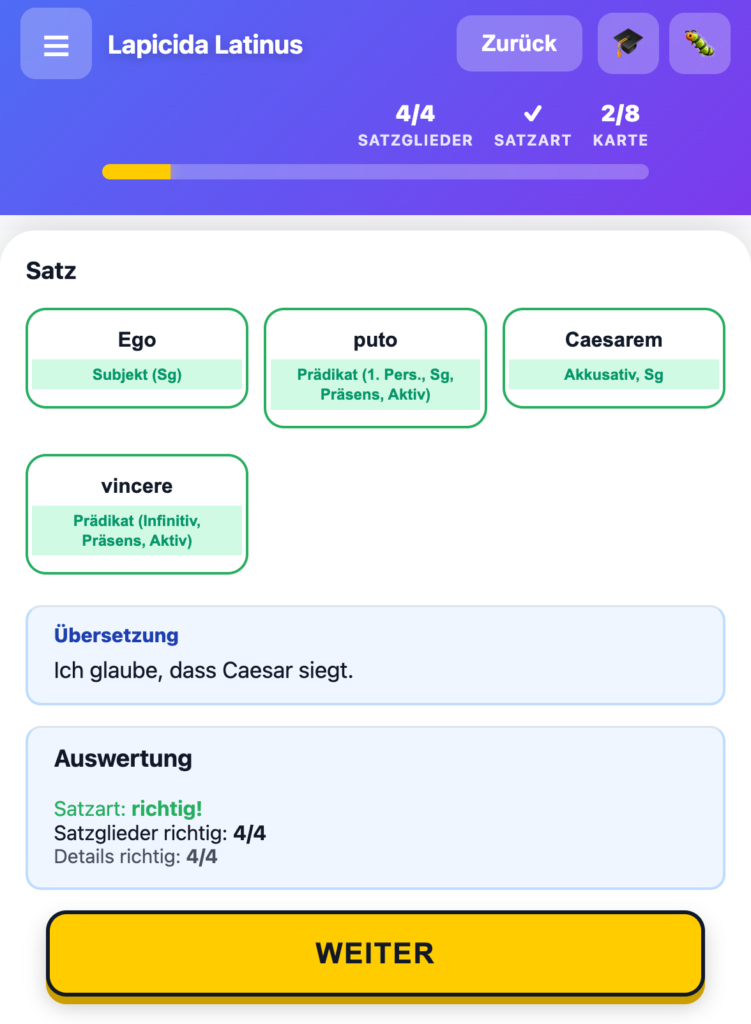
Recognize ACI in Latin with confidence — practice with the app
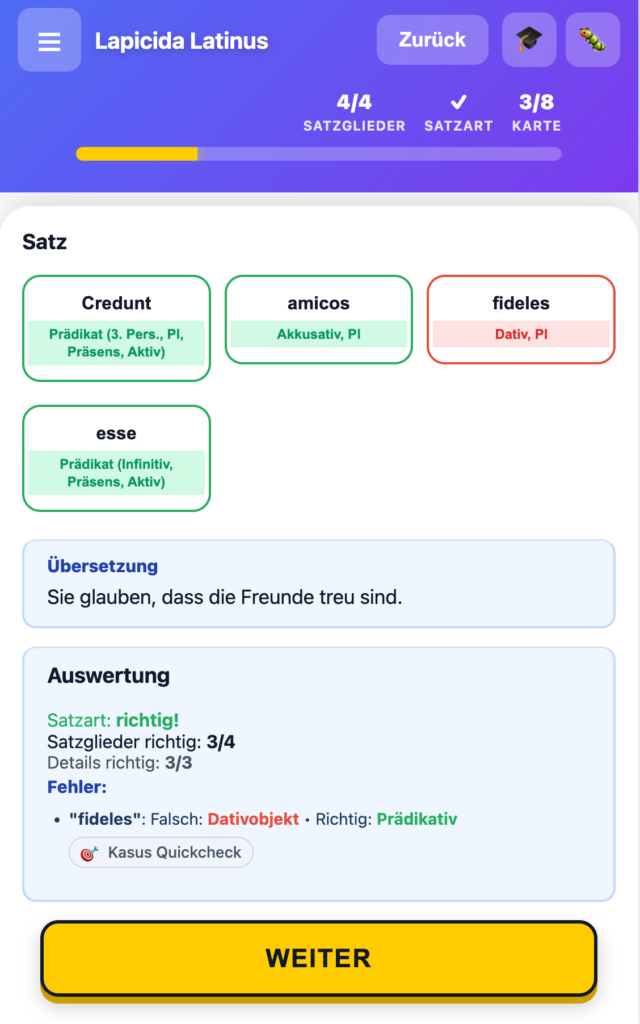
Understand Latin instead of cramming — try it right now.
Frequently Asked Questions About ACI in Latin
What does ACI mean in Latin?
What does ACI mean in Latin?
ACI stands for Accusativus cum Infinitivo — accusative with infinitive. It is a Latin sentence structure in which the subject of a subordinate clause is in the accusative case and the predicate appears as an infinitive, similar to a “dass” clause in German.
How do I recognize the ACI in Latin?
Three characteristics: (1) A main verb expressing saying, thinking, or perceiving. (2) An accusative that serves as the subject of the subordinate clause. (3) An infinitive (present, perfect, or future) as the predicate of the subordinate clause.
How do I translate the ACI into German?
Translate the ACI using a “dass” clause: The accusative object becomes the subject (nominative), and the infinitive becomes a conjugated verb. Example: Audivi Romam pulchram esse → I heard that Rome is beautiful.
What is the difference between the present, perfect, and future infinitives in the ACI?
Present infinitive (e.g., *esse*): The action occurs simultaneously with the main clause. Perfect infinitive (e.g., *fuisse*): The action occurred before the main clause. Future infinitive (e.g., futuram esse): The action takes place after the main clause.
After which verbs does the ACI come?
The ACI follows verbs of perception (audire, videre), speech (dicere, narrare), thought (putare, credere), knowledge (scire), and volition/hope (velle, sperare).
How do I form the future infinitive in the ACI?
Active future infinitive = future participle (ending in -urus/-ura/-urum) + esse. The participle agrees in case, gender, and number with the ACI subject. Example: Spero Romam pulchram futuram esse — “futuram” is feminine accusative singular because “Romam” is feminine.


